

1
创建新的 TanStack Start 应用
使用交互式 CLI 创建一个新的 TanStack Start 应用。
terminal
bunx @tanstack/cli create my-tanstack-app
2
启动开发服务器
切换到项目目录并使用 Bun 启动 Vite 开发服务器。
terminal
cd my-tanstack-app
bun --bun run dev
3
更新 package.json 中的脚本
在你的
package.json 的 scripts 字段中,为 Vite CLI 命令添加 bun --bun 前缀,以便 Bun 运行 Vite CLI 的 dev、build 和 preview 命令。package.json
{
  "scripts": {
    "dev": "bun --bun vite dev",
    "build": "bun --bun vite build",
    "serve": "bun --bun vite preview"
  }
}
托管
要在生产环境中托管你的 TanStack Start 应用,请使用 Nitro 或自定义 Bun 服务器。- Nitro
- 自定义服务器
1
将 Nitro 添加到你的项目
将 Nitro 添加到你的项目,以便将 TanStack Start 应用部署到不同平台。
terminal
bun add nitro
2
更新你的 vite.config.ts 文件
将 Nitro 插件添加到你的  vite.config.ts
vite.config.ts 文件中。vite.config.ts// 其他导入...
import { nitro } from "nitro/vite";
const config = defineConfig({
plugins: [
tanstackStart(),
nitro({ preset: "bun" }),
// 其他插件...
],
});
export default config;
bun 预设是可选的,但它会专门为 Bun 的运行配置构建输出。3
更新启动命令
确保你的
package.json 文件中存在 build 和 start 脚本:package.json
  {
    "scripts": {
      "build": "bun --bun vite build",
      // .output 文件由 Nitro 在你运行 `bun run build` 时创建。
      // 部署到 Vercel 时不需要。
      "start": "bun run .output/server/index.mjs"
    }
  }
部署到 Vercel 时,你不需要自定义
start 脚本。4
部署你的应用
使用以下指南之一将你的应用部署到托管提供商。
部署到 Vercel 时,要么将 vite.config.ts
"bunVersion": "1.x" 添加到你的 vercel.json 文件中,要么在 vite.config.ts 文件的 nitro 配置中设置 Bun 版本:部署到 Vercel 时,请不要使用
bun Nitro 预设。vite.config.tsexport default defineConfig({
plugins: [
tanstackStart(),
nitro({
preset: "bun",
vercel: {
functions: {
runtime: "bun1.x",
},
},
}),
],
});
此自定义服务器基于 TanStack 的 Bun 模板。它为你提供对静态资源服务的细粒度控制:小文件预加载到内存,大文件按需提供,并配有可配置的预加载限制。
1
创建生产服务器
在你的项目根目录下创建一个 server.ts
server.ts 文件:server.ts/**
* TanStack Start 生产服务器(Bun)
*
* 一个高性能的 TanStack Start 应用生产服务器,实现智能静态资源加载和可配置的内存管理。
*
* 功能:
* - 混合加载策略(预加载小文件,按需提供大文件)
* - 可配置的文件包含/排除模式
* - 内存高效的响应生成
* - 生产就绪的缓存头
*
* 环境变量:
*
* PORT(数字)
* - 服务器端口号
* - 默认值:3000
*
* ASSET_PRELOAD_MAX_SIZE(数字)
* - 预加载到内存的最大文件大小(字节)
* - 大于此值的文件将从磁盘按需提供
* - 默认值:5242880(5MB)
* - 示例:ASSET_PRELOAD_MAX_SIZE=5242880(5MB)
*
* ASSET_PRELOAD_INCLUDE_PATTERNS(字符串)
* - 逗号分隔的全局模式列表,用于包含文件
* - 如果指定,只有匹配的文件有资格预加载
* - 模式仅与文件名匹配,而非完整路径
* - 示例:ASSET_PRELOAD_INCLUDE_PATTERNS="*.js,*.css,*.woff2"
*
* ASSET_PRELOAD_EXCLUDE_PATTERNS(字符串)
* - 逗号分隔的全局模式列表,用于排除文件
* - 在包含模式之后应用
* - 模式仅与文件名匹配,而非完整路径
* - 示例:ASSET_PRELOAD_EXCLUDE_PATTERNS="*.map,*.txt"
*
* ASSET_PRELOAD_VERBOSE_LOGGING(布尔值)
* - 启用已加载和已跳过文件的详细日志
* - 默认值:false
* - 设置为 "true" 以启用详细输出
*
* ASSET_PRELOAD_ENABLE_ETAG(布尔值)
* - 为预加载的资源启用 ETag 生成
* - 默认值:true
* - 设置为 "false" 以禁用 ETag 支持
*
* ASSET_PRELOAD_ENABLE_GZIP(布尔值)
* - 为符合条件的资源启用 Gzip 压缩
* - 默认值:true
* - 设置为 "false" 以禁用 Gzip 压缩
*
* ASSET_PRELOAD_GZIP_MIN_SIZE(数字)
* - Gzip 压缩所需的最小文件大小(字节)
* - 小于此值的文件不会被压缩
* - 默认值:1024(1KB)
*
* ASSET_PRELOAD_GZIP_MIME_TYPES(字符串)
* - 逗号分隔的 MIME 类型列表,符合 Gzip 压缩条件
* - 支持以 "/" 结尾的部分匹配
* - 默认值:text/,application/javascript,application/json,application/xml,image/svg+xml
*
* 用法:
* bun run server.ts
*/
import path from 'node:path'
// 配置项
const SERVER_PORT = Number(process.env.PORT ?? 3000)
const CLIENT_DIRECTORY = './dist/client'
const SERVER_ENTRY_POINT = './dist/server/server.js'
// 用于专业输出的日志工具
const log = {
info: (message: string) => {
console.log(`[INFO] ${message}`)
},
success: (message: string) => {
console.log(`[SUCCESS] ${message}`)
},
warning: (message: string) => {
console.log(`[WARNING] ${message}`)
},
error: (message: string) => {
console.log(`[ERROR] ${message}`)
},
header: (message: string) => {
console.log(`\n${message}\n`)
},
}
// 环境变量中的预加载配置
const MAX_PRELOAD_BYTES = Number(
process.env.ASSET_PRELOAD_MAX_SIZE ?? 5 * 1024 * 1024, // 默认 5MB
)
// 解析逗号分隔的包含模式(无默认值)
const INCLUDE_PATTERNS = (process.env.ASSET_PRELOAD_INCLUDE_PATTERNS ?? '')
.split(',')
.map((s) => s.trim())
.filter(Boolean)
.map((pattern: string) => convertGlobToRegExp(pattern))
// 解析逗号分隔的排除模式(无默认值)
const EXCLUDE_PATTERNS = (process.env.ASSET_PRELOAD_EXCLUDE_PATTERNS ?? '')
.split(',')
.map((s) => s.trim())
.filter(Boolean)
.map((pattern: string) => convertGlobToRegExp(pattern))
// 详细日志标志
const VERBOSE = process.env.ASSET_PRELOAD_VERBOSE_LOGGING === 'true'
// 可选的 ETag 功能
const ENABLE_ETAG = (process.env.ASSET_PRELOAD_ENABLE_ETAG ?? 'true') === 'true'
// 可选的 Gzip 功能
const ENABLE_GZIP = (process.env.ASSET_PRELOAD_ENABLE_GZIP ?? 'true') === 'true'
const GZIP_MIN_BYTES = Number(process.env.ASSET_PRELOAD_GZIP_MIN_SIZE ?? 1024) // 1KB
const GZIP_TYPES = (
process.env.ASSET_PRELOAD_GZIP_MIME_TYPES ??
'text/,application/javascript,application/json,application/xml,image/svg+xml'
)
.split(',')
.map((v) => v.trim())
.filter(Boolean)
/**
* 将简单的全局模式转换为正则表达式
* 支持 * 通配符匹配任意字符
*/
function convertGlobToRegExp(globPattern: string): RegExp {
// 转义除 * 之外的正则特殊字符,然后将 * 替换为 .*
const escapedPattern = globPattern
.replace(/[-/\\^$+?.()|[\]{}]/g, '\\$&')
.replace(/\*/g, '.*')
return new RegExp(`^${escapedPattern}$`, 'i')
}
/**
* 为给定的数据缓冲区计算 ETag
*/
function computeEtag(data: Uint8Array): string {
const hash = Bun.hash(data)
return `W/"${hash.toString(16)}-${data.byteLength.toString()}"`
}
/**
* 预加载的静态资源元数据
*/
interface AssetMetadata {
route: string
size: number
type: string
}
/**
* 内存中的资源,支持 ETag 和 Gzip
*/
interface InMemoryAsset {
raw: Uint8Array
gz?: Uint8Array
etag?: string
type: string
immutable: boolean
size: number
}
/**
* 静态资源预加载过程的结果
*/
interface PreloadResult {
routes: Record<string, (req: Request) => Response | Promise<Response>>
loaded: AssetMetadata[]
skipped: AssetMetadata[]
}
/**
* 根据配置的模式检查文件是否有资格预加载
*/
function isFileEligibleForPreloading(relativePath: string): boolean {
const fileName = relativePath.split(/[/\\]/).pop() ?? relativePath
// 如果指定了包含模式,文件必须至少匹配一个
if (INCLUDE_PATTERNS.length > 0) {
if (!INCLUDE_PATTERNS.some((pattern) => pattern.test(fileName))) {
return false
}
}
// 如果指定了排除模式,文件不能匹配任何模式
if (EXCLUDE_PATTERNS.some((pattern) => pattern.test(fileName))) {
return false
}
return true
}
/**
* 检查 MIME 类型是否可压缩
*/
function isMimeTypeCompressible(mimeType: string): boolean {
return GZIP_TYPES.some((type) =>
type.endsWith('/') ? mimeType.startsWith(type) : mimeType === type,
)
}
/**
* 根据大小和 MIME 类型有条件地压缩数据
*/
function compressDataIfAppropriate(
data: Uint8Array,
mimeType: string,
): Uint8Array | undefined {
if (!ENABLE_GZIP) return undefined
if (data.byteLength < GZIP_MIN_BYTES) return undefined
if (!isMimeTypeCompressible(mimeType)) return undefined
try {
return Bun.gzipSync(data.buffer as ArrayBuffer)
} catch {
return undefined
}
}
/**
* 创建响应处理器函数,支持 ETag 和 Gzip
*/
function createResponseHandler(
asset: InMemoryAsset,
): (req: Request) => Response {
return (req: Request) => {
const headers: Record<string, string> = {
'Content-Type': asset.type,
'Cache-Control': asset.immutable
? 'public, max-age=31536000, immutable'
: 'public, max-age=3600',
}
if (ENABLE_ETAG && asset.etag) {
const ifNone = req.headers.get('if-none-match')
if (ifNone && ifNone === asset.etag) {
return new Response(null, {
status: 304,
headers: { ETag: asset.etag },
})
}
headers.ETag = asset.etag
}
if (
ENABLE_GZIP &&
asset.gz &&
req.headers.get('accept-encoding')?.includes('gzip')
) {
headers['Content-Encoding'] = 'gzip'
headers['Content-Length'] = String(asset.gz.byteLength)
const gzCopy = new Uint8Array(asset.gz)
return new Response(gzCopy, { status: 200, headers })
}
headers['Content-Length'] = String(asset.raw.byteLength)
const rawCopy = new Uint8Array(asset.raw)
return new Response(rawCopy, { status: 200, headers })
}
}
/**
* 从包含模式创建复合全局模式
*/
function createCompositeGlobPattern(): Bun.Glob {
const raw = (process.env.ASSET_PRELOAD_INCLUDE_PATTERNS ?? '')
.split(',')
.map((s) => s.trim())
.filter(Boolean)
if (raw.length === 0) return new Bun.Glob('**/*')
if (raw.length === 1) return new Bun.Glob(raw[0])
return new Bun.Glob(`{${raw.join(',')}}`)
}
/**
* 使用智能预加载策略初始化静态路由
* 小文件加载到内存,大文件按需提供
*/
async function initializeStaticRoutes(
clientDirectory: string,
): Promise<PreloadResult> {
const routes: Record<string, (req: Request) => Response | Promise<Response>> =
{}
const loaded: AssetMetadata[] = []
const skipped: AssetMetadata[] = []
log.info(`正在从 ${clientDirectory} 加载静态资源...`)
if (VERBOSE) {
console.log(
`最大预加载大小:${(MAX_PRELOAD_BYTES / 1024 / 1024).toFixed(2)} MB`,
)
if (INCLUDE_PATTERNS.length > 0) {
console.log(
`包含模式:${process.env.ASSET_PRELOAD_INCLUDE_PATTERNS ?? ''}`,
)
}
if (EXCLUDE_PATTERNS.length > 0) {
console.log(
`排除模式:${process.env.ASSET_PRELOAD_EXCLUDE_PATTERNS ?? ''}`,
)
}
}
let totalPreloadedBytes = 0
try {
const glob = createCompositeGlobPattern()
for await (const relativePath of glob.scan({ cwd: clientDirectory })) {
const filepath = path.join(clientDirectory, relativePath)
const route = `/${relativePath.split(path.sep).join(path.posix.sep)}`
try {
// 获取文件元数据
const file = Bun.file(filepath)
// 如果文件不存在或为空则跳过
if (!(await file.exists()) || file.size === 0) {
continue
}
const metadata: AssetMetadata = {
route,
size: file.size,
type: file.type || 'application/octet-stream',
}
// 确定文件是否应预加载
const matchesPattern = isFileEligibleForPreloading(relativePath)
const withinSizeLimit = file.size <= MAX_PRELOAD_BYTES
if (matchesPattern && withinSizeLimit) {
// 将小文件预加载到内存,支持 ETag 和 Gzip
const bytes = new Uint8Array(await file.arrayBuffer())
const gz = compressDataIfAppropriate(bytes, metadata.type)
const etag = ENABLE_ETAG ? computeEtag(bytes) : undefined
const asset: InMemoryAsset = {
raw: bytes,
gz,
etag,
type: metadata.type,
immutable: true,
size: bytes.byteLength,
}
routes[route] = createResponseHandler(asset)
loaded.push({ ...metadata, size: bytes.byteLength })
totalPreloadedBytes += bytes.byteLength
} else {
// 按需提供大文件或过滤后的文件
routes[route] = () => {
const fileOnDemand = Bun.file(filepath)
return new Response(fileOnDemand, {
headers: {
'Content-Type': metadata.type,
'Cache-Control': 'public, max-age=3600',
},
})
}
skipped.push(metadata)
}
} catch (error: unknown) {
if (error instanceof Error && error.name !== 'EISDIR') {
log.error(`加载 ${filepath} 失败:${error.message}`)
}
}
}
// 仅在详细模式下显示详细文件概览
if (VERBOSE && (loaded.length > 0 || skipped.length > 0)) {
const allFiles = [...loaded, ...skipped].sort((a, b) =>
a.route.localeCompare(b.route),
)
// 计算最大路径长度用于对齐
const maxPathLength = Math.min(
Math.max(...allFiles.map((f) => f.route.length)),
60,
)
// 格式化文件大小(KB 和实际 gzip 大小)
const formatFileSize = (bytes: number, gzBytes?: number) => {
const kb = bytes / 1024
const sizeStr = kb < 100 ? kb.toFixed(2) : kb.toFixed(1)
if (gzBytes !== undefined) {
const gzKb = gzBytes / 1024
const gzStr = gzKb < 100 ? gzKb.toFixed(2) : gzKb.toFixed(1)
return {
size: sizeStr,
gzip: gzStr,
}
}
// 如果无实际 gzip 数据,粗略估算(通常 30-70% 压缩率)
const gzipKb = kb * 0.35
return {
size: sizeStr,
gzip: gzipKb < 100 ? gzipKb.toFixed(2) : gzipKb.toFixed(1),
}
}
if (loaded.length > 0) {
console.log('\n📁 预加载到内存:')
console.log(
'路径 │ 大小 │ 压缩后大小',
)
loaded
.sort((a, b) => a.route.localeCompare(b.route))
.forEach((file) => {
const { size, gzip } = formatFileSize(file.size)
const paddedPath = file.route.padEnd(maxPathLength)
const sizeStr = `${size.padStart(7)} kB`
const gzipStr = `${gzip.padStart(7)} kB`
console.log(`${paddedPath} │ ${sizeStr} │ ${gzipStr}`)
})
}
if (skipped.length > 0) {
console.log('\n💾 按需提供:')
console.log(
'路径 │ 大小 │ 压缩后大小',
)
skipped
.sort((a, b) => a.route.localeCompare(b.route))
.forEach((file) => {
const { size, gzip } = formatFileSize(file.size)
const paddedPath = file.route.padEnd(maxPathLength)
const sizeStr = `${size.padStart(7)} kB`
const gzipStr = `${gzip.padStart(7)} kB`
console.log(`${paddedPath} │ ${sizeStr} │ ${gzipStr}`)
})
}
}
// 如果启用详细模式
if (VERBOSE) {
if (loaded.length > 0 || skipped.length > 0) {
const allFiles = [...loaded, ...skipped].sort((a, b) =>
a.route.localeCompare(b.route),
)
console.log('\n📊 详细文件信息:')
console.log(
'状态 │ 路径 │ MIME 类型 │ 原因',
)
allFiles.forEach((file) => {
const isPreloaded = loaded.includes(file)
const status = isPreloaded ? 'MEMORY' : 'ON-DEMAND'
const reason =
!isPreloaded && file.size > MAX_PRELOAD_BYTES
? '太大'
: !isPreloaded
? '已过滤'
: '已预加载'
const route =
file.route.length > 30
? file.route.substring(0, 27) + '...'
: file.route
console.log(
`${status.padEnd(12)} │ ${route.padEnd(30)} │ ${file.type.padEnd(28)} │ ${reason.padEnd(10)}`,
)
})
} else {
console.log('\n📊 没有找到要显示的文件')
}
}
// 在文件列表后打印摘要
console.log()
if (loaded.length > 0) {
log.success(
`已预加载 ${String(loaded.length)} 个文件(${(totalPreloadedBytes / 1024 / 1024).toFixed(2)} MB)到内存`,
)
} else {
log.info('没有文件预加载到内存')
}
if (skipped.length > 0) {
const tooLarge = skipped.filter((f) => f.size > MAX_PRELOAD_BYTES).length
const filtered = skipped.length - tooLarge
log.info(
`${String(skipped.length)} 个文件将按需提供(${String(tooLarge)} 个太大,${String(filtered)} 个已过滤)`,
)
}
} catch (error) {
log.error(
`从 ${clientDirectory} 加载静态文件失败:${String(error)}`,
)
}
return { routes, loaded, skipped }
}
/**
* 初始化服务器
*/
async function initializeServer() {
log.header('启动生产服务器')
// 加载 TanStack Start 服务器处理器
let handler: { fetch: (request: Request) => Response | Promise<Response> }
try {
const serverModule = (await import(SERVER_ENTRY_POINT)) as {
default: { fetch: (request: Request) => Response | Promise<Response> }
}
handler = serverModule.default
log.success('TanStack Start 应用处理器已初始化')
} catch (error) {
log.error(`加载服务器处理器失败:${String(error)}`)
process.exit(1)
}
// 使用智能预加载构建静态路由
const { routes } = await initializeStaticRoutes(CLIENT_DIRECTORY)
// 创建 Bun 服务器
const server = Bun.serve({
port: SERVER_PORT,
routes: {
// 提供静态资源(预加载或按需)
...routes,
// 所有其他路由回退到 TanStack Start 处理器
'/*': (req: Request) => {
try {
return handler.fetch(req)
} catch (error) {
log.error(`服务器处理器错误:${String(error)}`)
return new Response('Internal Server Error', { status: 500 })
}
},
},
// 全局错误处理器
error(error) {
log.error(
`未捕获的服务器错误:${error instanceof Error ? error.message : String(error)}`,
)
return new Response('Internal Server Error', { status: 500 })
},
})
log.success(`服务器正在 http://localhost:${String(server.port)} 上监听`)
}
// 初始化服务器
initializeServer().catch((error: unknown) => {
log.error(`启动服务器失败:${String(error)}`)
process.exit(1)
})
2
更新 package.json 脚本
添加一个
start 脚本来运行自定义服务器:package.json
{
  "scripts": {
    "build": "bun --bun vite build",
    "start": "bun run server.ts"
  }
}
3
构建并运行
构建你的应用程序并启动服务器:服务器默认监听 3000 端口;设置
terminal
bun run build
bun run start
PORT 环境变量来更改它。
Vercel
在 Vercel 上部署

Render
在 Render 上部署

Railway
在 Railway 上部署

DigitalOcean
在 DigitalOcean 上部署

AWS Lambda
在 AWS Lambda 上部署

Google Cloud Run
在 Google Cloud Run 上部署
模板
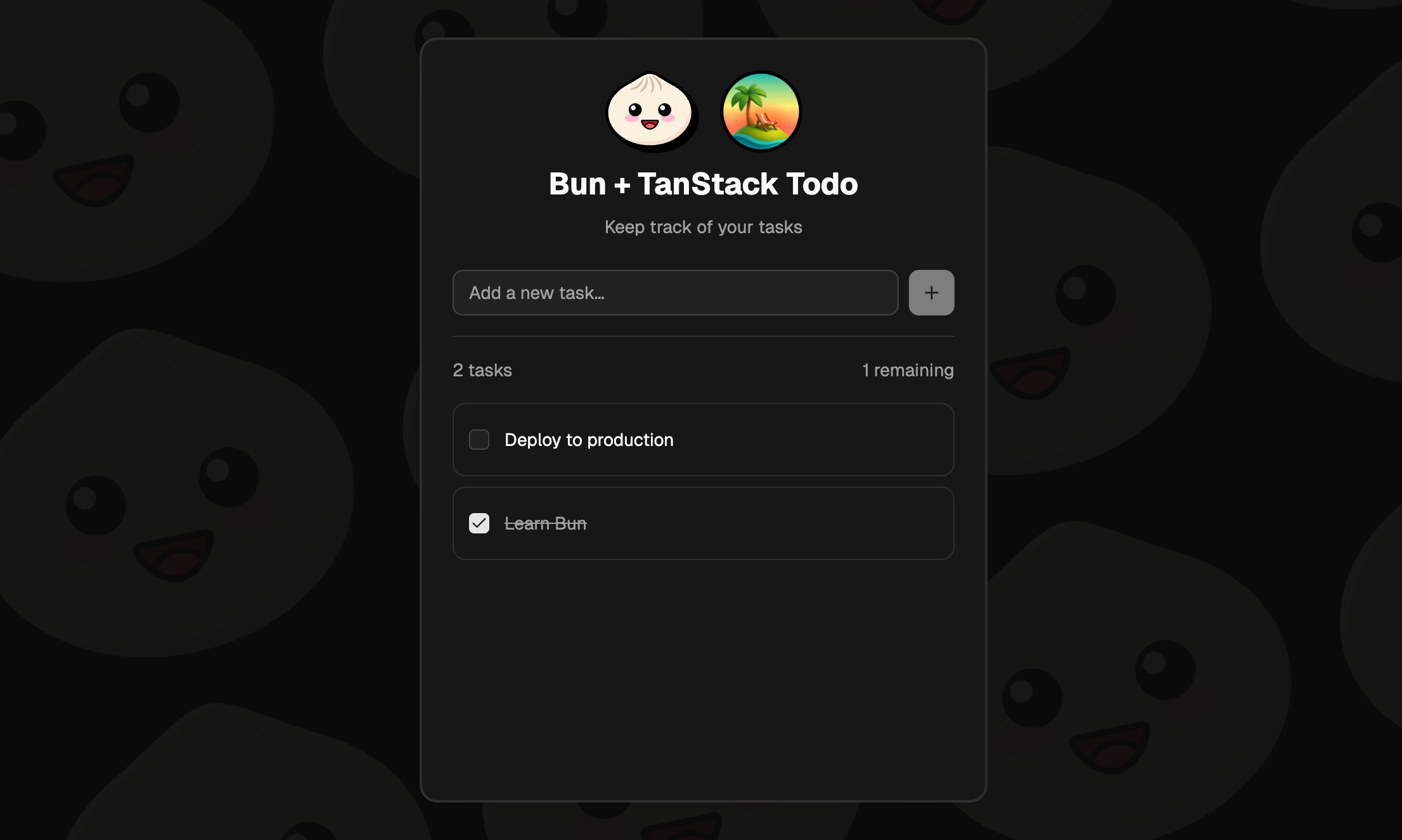
Todo 应用(Tanstack + Bun)
一个使用 Bun、TanStack Start 和 PostgreSQL 构建的待办事项应用。
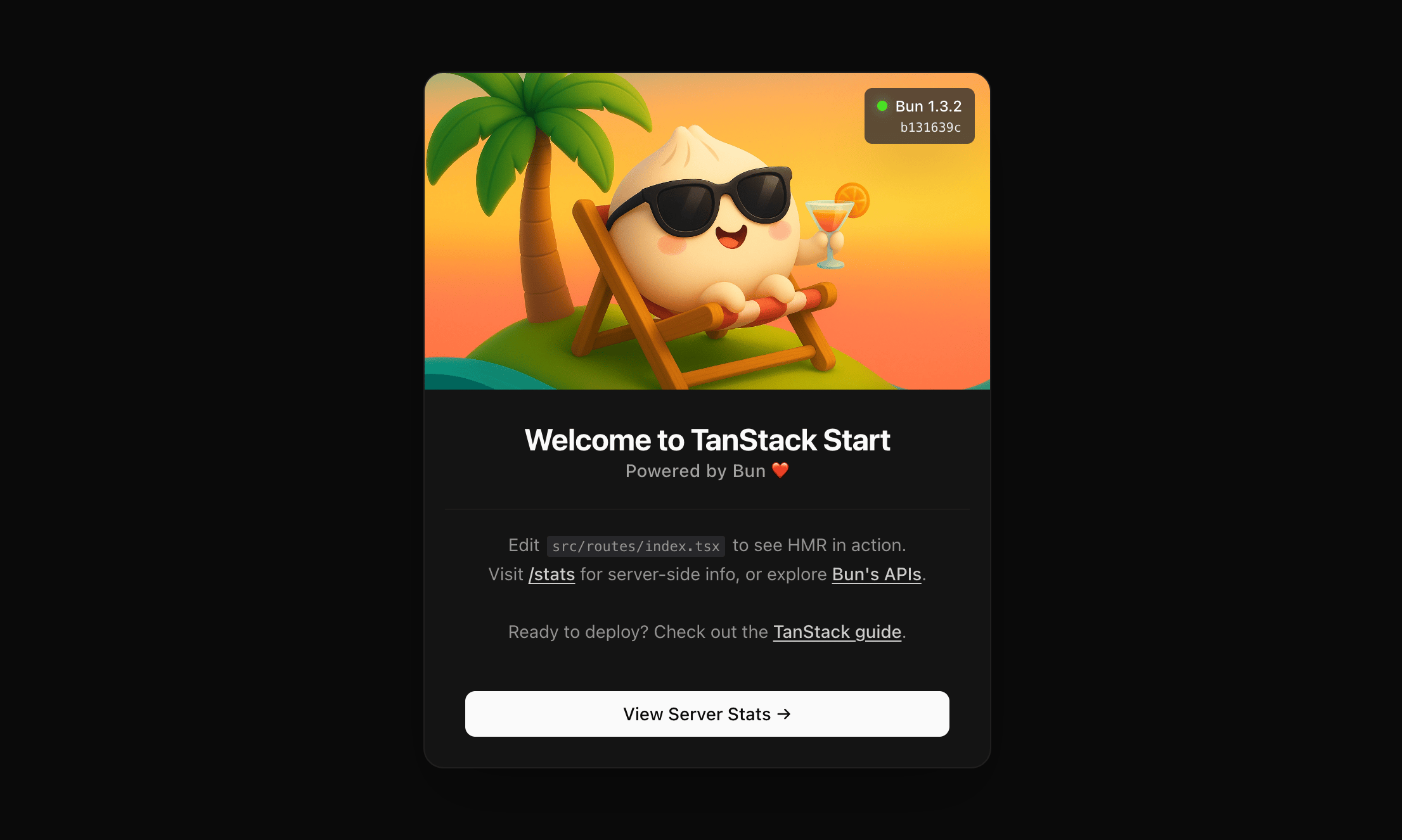
Bun + TanStack Start 应用
一个使用 Bun、SSR 和基于文件的路由的 TanStack Start 模板。
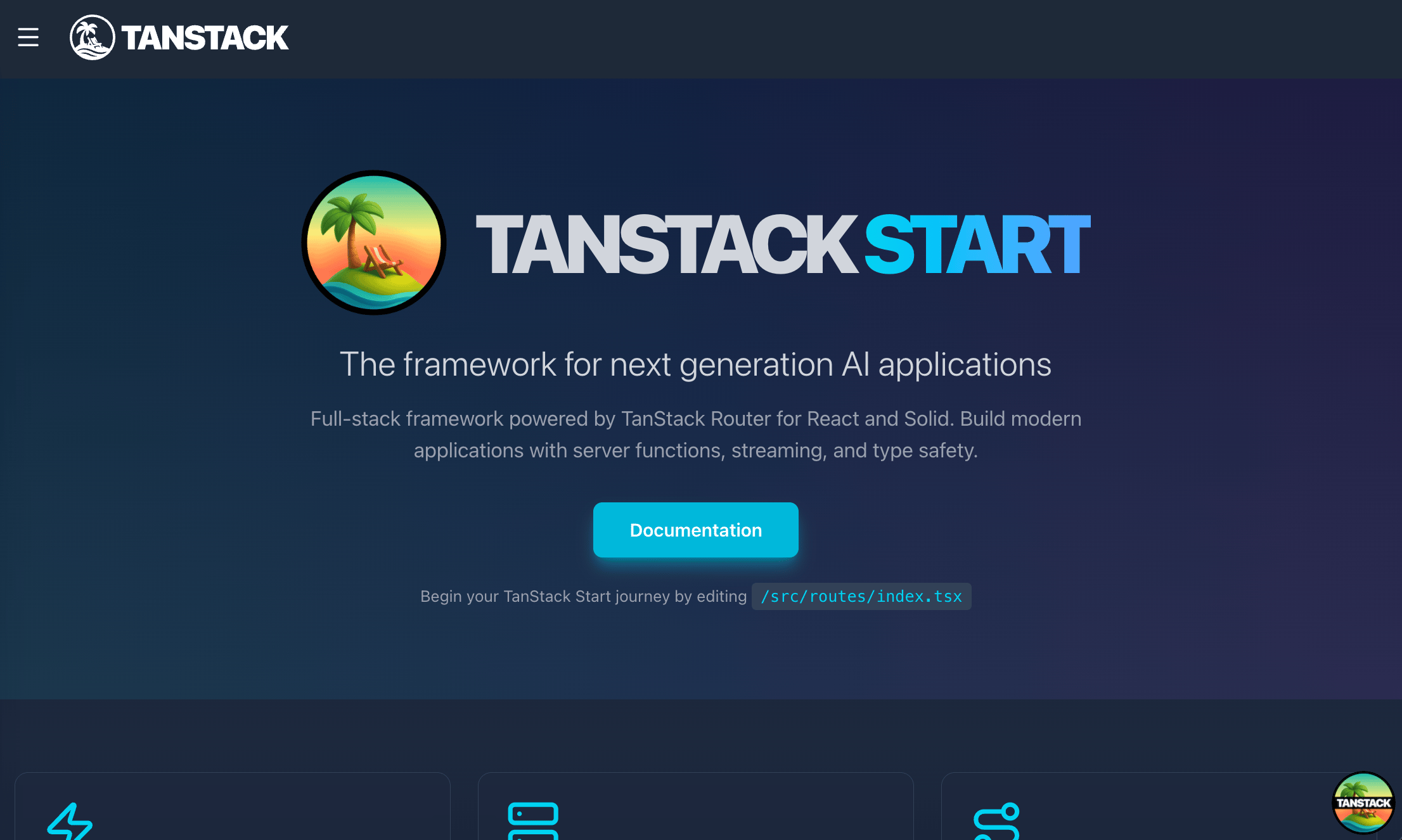
Bun + Tanstack 基础启动模板
使用 Bun 运行时和 Bun 文件 API 的基础 TanStack 启动模板。
→ 查看 TanStack Start 的托管文档